Understanding the CrowdStrike Outage: What Actually Happened and What It Means for Security Architecture
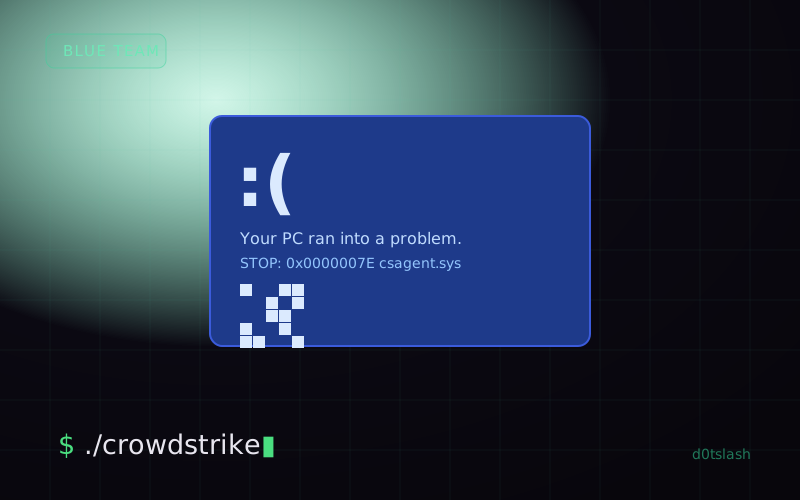
On July 19 2024, a faulty content update from CrowdStrike caused approximately 8.5 million Windows systems to crash globally. This is a technical breakdown of what happened and what it reveals about the risks of kernel-level security software.
Introduction
On July 19, 2024, the world woke up to blue screens. Approximately 8.5 million Windows systems crashed simultaneously, affecting airlines, hospitals, banks, broadcasters, and emergency services globally. The cause was a single faulty channel file update pushed by CrowdStrike to its Falcon sensor.
This was not a cyberattack. It was a software update gone wrong. And it caused more visible disruption than most actual cyberattacks in recent memory.
What Technically Happened
CrowdStrike Falcon operates as a kernel-level driver on Windows systems. This gives it deep visibility into system behaviour — but it also means bugs in the sensor code or its configuration can trigger kernel panics.
The update in question was to Channel File 291, which contains configuration for a Falcon component that evaluates named pipe execution on Windows. The update introduced a logic error that caused the sensor to attempt reading memory at an invalid address, triggering a null pointer dereference and crashing the Windows kernel — producing the blue screen of death.
The update was pushed automatically to all Falcon-protected Windows systems globally. There was no staged rollout. Every system pulled the update simultaneously and crashed on next reboot or sensor restart.
Why Recovery Was So Hard
The remediation required manual intervention on each affected machine. Administrators had to boot into Safe Mode or Windows Recovery Environment, navigate to the CrowdStrike directory, and delete the problematic channel file. On systems with BitLocker encryption, this required the BitLocker recovery key — which many organisations struggled to locate quickly.
Cloud-hosted virtual machines were somewhat easier to remediate. Physical machines in remote locations, embedded systems, and devices without accessible recovery mechanisms took days to fix.
Architectural Lessons
Kernel-level access is a double-edged sword. The same privileged access that makes endpoint security tools effective is what makes their failures catastrophic. Microsoft has since announced plans to work with security vendors to move more operations out of the kernel following this incident.
Staged rollouts are not optional. A software update that goes to 100% of your install base simultaneously has no circuit breaker. If it is broken, you find out when everything breaks. Canary deployments, staged rollouts, and kill switches should be non-negotiable for any software operating at this level.
Test in production-equivalent environments. The faulty file passed CrowdStrike's internal testing. The testing environment clearly did not adequately replicate conditions in the real world.
Recovery planning must include worst-case endpoint scenarios. How quickly can your organisation recover 1000 machines that require manual remediation? Most organisations discovered the honest answer to this question on July 19.
Conclusion
The CrowdStrike incident is a case study in systemic risk. A single software update from a trusted vendor caused more disruption than most nation-state attacks. Security architecture needs to account for the possibility that security tools themselves can be the failure point — and build resilience accordingly.